Field notes
Where two official wordings sit together
The stories on this site are told from official pages. A few of those pages say almost the same thing in slightly different official clothes, and those nuances live here, rather than on the desk.
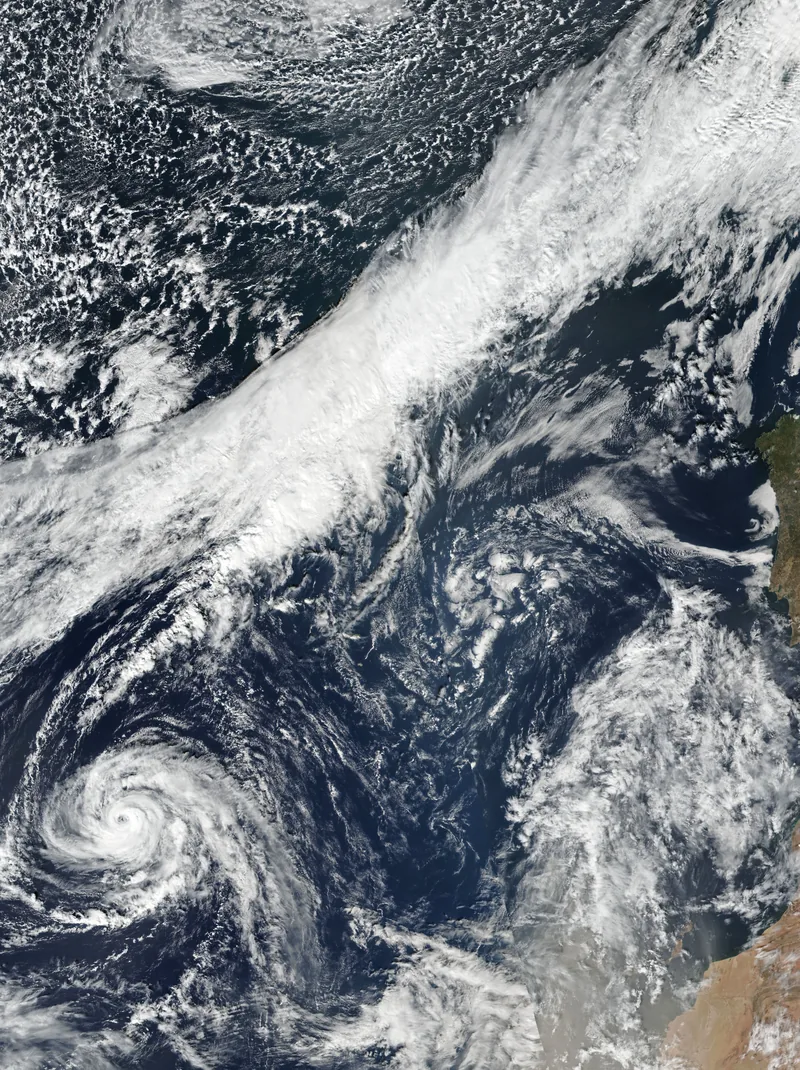
Two official sentences for the same naming rule
The UK Storm Centre says a storm will be named “when it has the potential to cause disruption or damage which could result in an amber or red warning.” The 2026/27 names announcement says storms are named “when they have the potential to cause medium or high impacts in the UK, Ireland and the Netherlands. This would typically mean an amber or red warning is expected to be issued at some point during the event.” Both sentences are official. This site quotes them as they stand, and does not blend them into a single invented rule. [source] [source]
Who put a name on the list, and who later names a storm
The official announcement prints, after each name, the service that put it on the jointly selected list. That is not automatically the service that will later name a storm of that name. When the criteria are met, “either the Met Office, Met Éireann or KNMI can name a storm, taking the name from the latest list in alphabetical order.” [source] [source]
The Met Office’s wording about National Hurricane Center practice
The Storm Centre, writing about the North Atlantic, says tropical or subtropical cyclones “are named by the National Hurricane Centre when they are judged to have intensified into a tropical storm with winds of at least 65 km/h, (40 mph).” That is the Met Office’s wording about the NHC, and is kept as such, rather than rewritten as a National Hurricane Center sentence. [source]
Force 9 has an official term, and a Met Office descriptive term
On the official Beaufort page, Force 9 is “Strong gale.” A footnote adds: “The official term is Strong gale, however, the Met Office uses the descriptive term Severe gale.” This site keeps both wordings, and does not pick one as if the other were a mistake. [source]
Hurricane, hurricane force, and a true tropical cyclone
On the Beaufort table, Force 12 is printed as “Hurricane.” In warnings, the Met Office glossary uses “hurricane force.” “The term ‘hurricane’ on its own means a true tropical cyclone, not experienced in British waters.” Those three official uses are kept distinct. [source]
Goretti’s survey belongs to that storm
The 93% and 88% figures come from post-event surveys after Storm Goretti in January 2026, as reported on the official names announcement. They are not a general measure for every named storm. [source]
Two official lists, compared only as published
On the published 2026–27 western-group list and the published 2026 Atlantic list, checked on 17 November 2026, the two lists share no names. That is a statement about those pages, in that year, not a rule that the lists can never coincide. [source] [source]
Keep exploring
- Sources — the official pages quoted throughout.
- The fact file — each sentence kept close to its source.
- When is a storm named? — the story, told without the footnotes first.
Enjoyed this naming desk?
No pop-ups. No intrusive advertising. Just interesting stuff. A little support helps the next storms site get built.